Interview with Srdjan Uljevic, Assistant professor at the AUCA GenEd Faculty
April 14, 2026
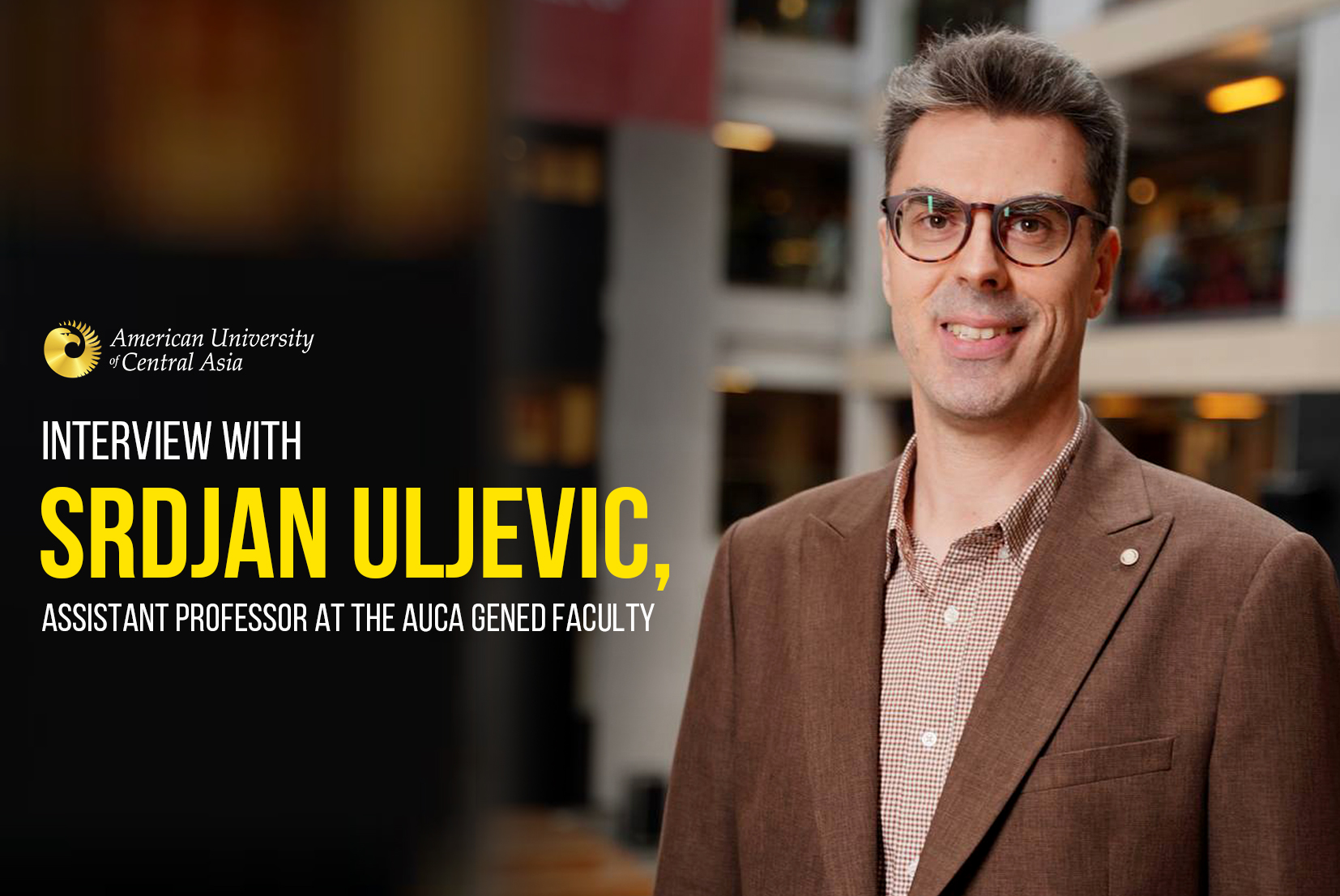
In this interview, Srdjan Uljevic, Assistant Professor at the AUCA GenEd Faculty , shares his perspective on the importance of building a strong academic foundation before pursuing studies abroad. Drawing on his interdisciplinary teaching experience, he discusses the challenges students often face when moving overseas immediately after high school and emphasizes the value of completing undergraduate education in a familiar cultural and social environment.
Ìý
Dear Professor, please briefly introduce yourself.Ìý
— My name is Srdjan Uljevic. I’ve been with AUCA since 2017. I teach the First Year and Second Year Seminar (FYS and SYS) at General Education Program. Because my academic background is interdisciplinary, over the past 8 years, I have taught a number of diverse courses, including for School of Entrepreneurship and Business Administration (SEBA) and International and Comparative Politics (ICP).
Ìý
Why it is important not to rush into studying abroad immediately after school?
— Living alone is hard. But living alone and abroad is even harder. In my experience talking to students over the years, many are lured by the promise of freedom. They imagine a carefree life in a new environment. But that’s not what often times happens. In reality, students studying abroad find themselves devoting a considerable amount of time and energy to daily chores, things that others do for them at home. Many, thus, feel overwhelmed. This then takes away from learning. Undergraduate education is demanding. Immediate social support matters. In my opinion, post-graduate education is a more appropriate time to go abroad. Undergraduate education is once in a lifetime, post-grad, several times!
Ìý
How does AUCA prepare students to be competitive applicants for graduate programs abroad?
— What makes AUCA unique is its liberal arts mission. Students are required to take a number of courses from non-major programs. This means that, for example, a student studying software engineering will take courses in humanities and social sciences. Such a requirement together with the First Year and Second Year Seminar – two courses I personally consider to form the core of AUCA’s liberal art education – is the best guarantee of fostering critical thinking and analytical skills - fundamental qualities that will help with any graduate program.ÌýÌýÌýÌý
Ìý
In your experience, what advantages do students gain when they begin their higher education in a familiar cultural and social environment?Ìý
— As I have already mentioned above, there is an advantage in doing an undergraduate degree at home because a student can fully devote his/her time and energies to studying and academic development.
Ìý
What role does faculty mentorship and academic support play in helping students succeed throughout their university journey?Ìý
— Small class sizes are another strong feature of AUCA’s liberal arts mission. Class size allows for meaningful exchanges on a weekly basis which serves as the basis of genuine rapport between teachers and students. It is on the foundation of such rapport that mentorship and academic support is built upon. AUCA, therefore, offers an advantage over many other non-liberal arts universities in Kyrgyzstan or abroad.
Ìý
